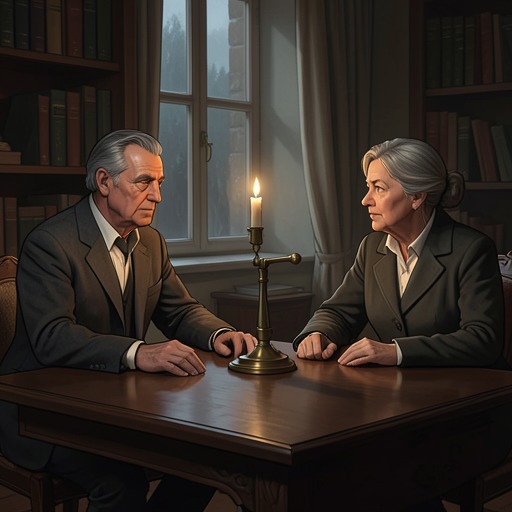
Marco Carrera and Probo Carrera's father-son relationship
The HummingbirdMarco Carrera and Probo Carrera's father-son relationship develops through a defining disagreement over Marco’s growth, a hard-won shared decision to seek treatment, and Marco’s later care for his father through cancer. Their bond is neither easy nor simply expressed: it takes shape in arguments, practical responsibilities, and belated efforts to stand on the same side.
Childhood and the dispute over growth
For years, Marco’s mother, Letizia Delvecchio, treated his small stature as part of his distinctive nature and called him her hummingbird, emphasizing his grace, beauty, and speed. Probo Carrera did not share her confidence. He tried to accept her reassurances while Marco was a child, but as adolescence began without the expected physical development, his concern sharpened into guilt that they had allowed the problem to go unaddressed.
When Marco was fourteen, Probo initiated consultations and tests. They established that Marco had moderate, non-serious statural hypoevolutism caused by insufficient growth-hormone production. There was no established treatment at the time, and the available experimental protocols were generally reserved for severe cases. A pediatric endocrinologist in Milan, Dr. Vavassori, nevertheless believed Marco could be helped through a program he had been conducting for several years.
The proposed treatment brought the parents’ differing convictions into the open. Probo regarded intervention as a necessary response to a medical condition; Letizia feared that it meant interfering with nature and held to the idea of Marco’s harmonious, hummingbird-like growth. Their argument widened into a dispute about nature, science, and the meaning of growth. It was not merely a disagreement over a doctor: each parent’s view of Marco, and of what care required, was at stake.
A decision reached together
The conflict did not end with one parent simply prevailing. After a family crisis brought Letizia and Probo back into alignment, they made an effort to meet each other’s position. Letizia began to relinquish what her analyst called the myth of the hummingbird and to consider Probo’s belief that they should do what science could offer to help their son grow.
Probo, in turn, tried not to treat his position as a personal victory. He still loved Letizia and saw the proposed treatment as a chance for them to share responsibility for something important. He brought her to meet Dr. Vavassori in Milan, asked her to assess the proposed treatment independently, and agreed to take her judgment into account before they decided. Letizia repeated the research Probo had already undertaken and concluded that the program was the only serious possibility the medical community of their time could offer. Their agreement did not erase the years of disagreement, but for once they were moving along the same path.
Care within the family
The novel also places Marco’s attentive fatherhood beside the relationship he had with Probo. When Marco’s young daughter, Adele Carrera, told him she had a thread attached to her back and extending to the nearest wall, he questioned her carefully about how it worked. Her explanation—that she had to mind the thread and prevent others from becoming caught in it—became a moment of recognition between father and daughter. Later, Dr. Nocetti interpreted the thread as a sign of Adele’s close and exclusive bond with her father, rooted in fear of losing him, and advised that she spend much more time with Marco.
Marco reorganized his life around that advice. He drove Adele to school, took on responsibilities previously handled by Marina Molitor, and reduced both his secondary pursuits and some professional commitments. The change was not experienced simply as sacrifice: he found himself feeling better. This later caregiving does not make Marco and Probo’s bond identical to Marco’s relationship with his daughter, but it places fatherhood and care at the center of the family’s unfolding generations.
Illness and reciprocal care
Years later, Probo’s illness gave Marco a sustained opportunity to care for his father. A biopsy following the discovery of occult blood in a routine examination confirmed adenocarcinoma. Probo underwent intestinal surgery, but metastases later appeared in his liver and a lung. His treatment proceeded in repeated seasonal cycles of intensive chemotherapy, a spring break, summer rest, and resumption in autumn. The oncologist believed that, if Probo’s physical and emotional condition held up, he might live for years with an appreciable quality of life.
Marco took on the practical work from the beginning. He accompanied Probo to chemotherapy, monitored side effects and medication, took him to scans, and arranged for a nurse to come to the house for blood tests. He was also working and caring for Adele, but he regarded the demands of assistance as small beside the burden of the illness itself. The account makes the care concrete: the father’s treatment depended not only on medical decisions but on repeated transport, monitoring, and attention at home.
As Probo’s illness progressed, Marco’s brother Giacomo Carrera also returned to help. Giacomo devoted himself to their parents’ needs, while Marco balanced that work with his job and his responsibilities to Adele. The brothers’ different forms of service did not resolve their own strained relationship; their shared presence in the family home instead shows how illness gathered the family around Probo and Letizia even where old tensions remained.
Memory, loss, and the relationship’s meaning
A small piece of evidence from Probo’s life captures the family’s history at an earlier threshold. In a Urania novel bought during the 1966 Florence flood, Marco found a pencil note in his father’s handwriting imagining the arrival of the newborn Giacomo without yet knowing whether the baby was a boy or a girl. Probo had been waiting in a hospital corridor, and the playful inscription records his excitement before the child’s sex was known. The novel thus preserved a private trace of fatherhood amid a public disaster.
Another object marks the relationship’s ending in time: The communes of 2000, by Mack Reynolds, dated August 23, 1981, was the final Urania book Probo bought and read. It was the last book in his nearly complete collection, numbered from 1 to 899, and the last of his life. Its significance is not simply bibliographic. The account connects an ordinary habit of reading to the point at which all subsequent issues became irrelevant to Probo.
Across these scenes, Marco and Probo’s relationship is defined by care that is sometimes difficult to express directly. Probo’s alarm over Marco’s growth becomes a shared medical decision rather than a permanent contest; Marco’s later assistance makes filial responsibility a series of daily acts. Their story also belongs to a family marked by bereavement and unresolved divisions, so practical care cannot undo every injury. It does, however, show the father-son bond persisting through disagreement, illness, and the objects that remain after a life has ended.